KK
Work
About

Purina
Streamlining field sales through paperless trial tracking and data collection.
Role
Lead Product Designer
Rest of team
Project Manager | Support Product Designer | Lead Engineer & Team
Overview
Challenge
The Purina sales team is busy. They are in the field (literally) at horse barns and feed distributors daily. Feed and supplement trials are the number one conversion tool for the sales team, but rely on data collection that historically has been done via pen and paper. You can imagine the amount of misplaced and incorrectly filled out forms.
Solution
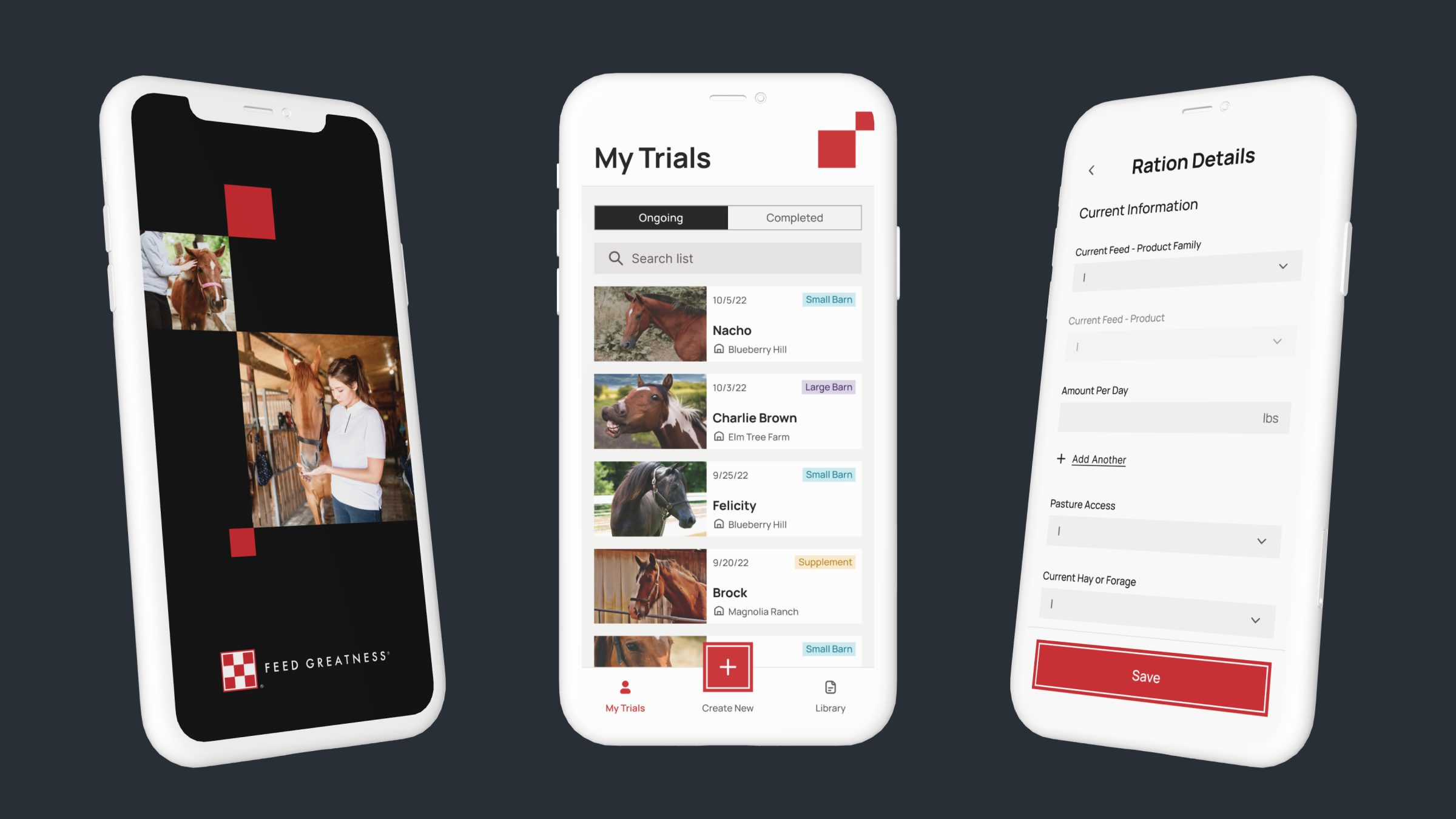
We designed and developed a sales enablement tool that leaves the paper processes behind and centralizes trial data. This means a streamlined data entry process, easier access to a library of past trials, as well as access to trial data for other business units. We also met the technical requirements of integrating with Power BI and deployment within their existing sales tool, Modus.
Impact
The app was launched to 500+ folks in Fall 2024 at Purina’s National Sales Meeting. Initial feedback was extremely positive, with excitement to “finally have a tool like this one after years of inconsistent and old school tracking methodology”.
The team hopes to add support for additional animal species in the near future.
Discovery
Workshop
Purina came to us with their goals and objectives, as well as some initial requirements for the app. With that in mind, our initial workshop was designed to align our teams and fill in the details by defining users and their needs; main user flows and data capture requirements; and short, medium, and long-term goals for the application.
🔮 Product vision
The Vision: “Provide sales team an easily usable app interface for tracking trial journey. Ability to search and leverage past trial results to show proof of trial success and help facilitate new trials.”
Jobs-to-be-done
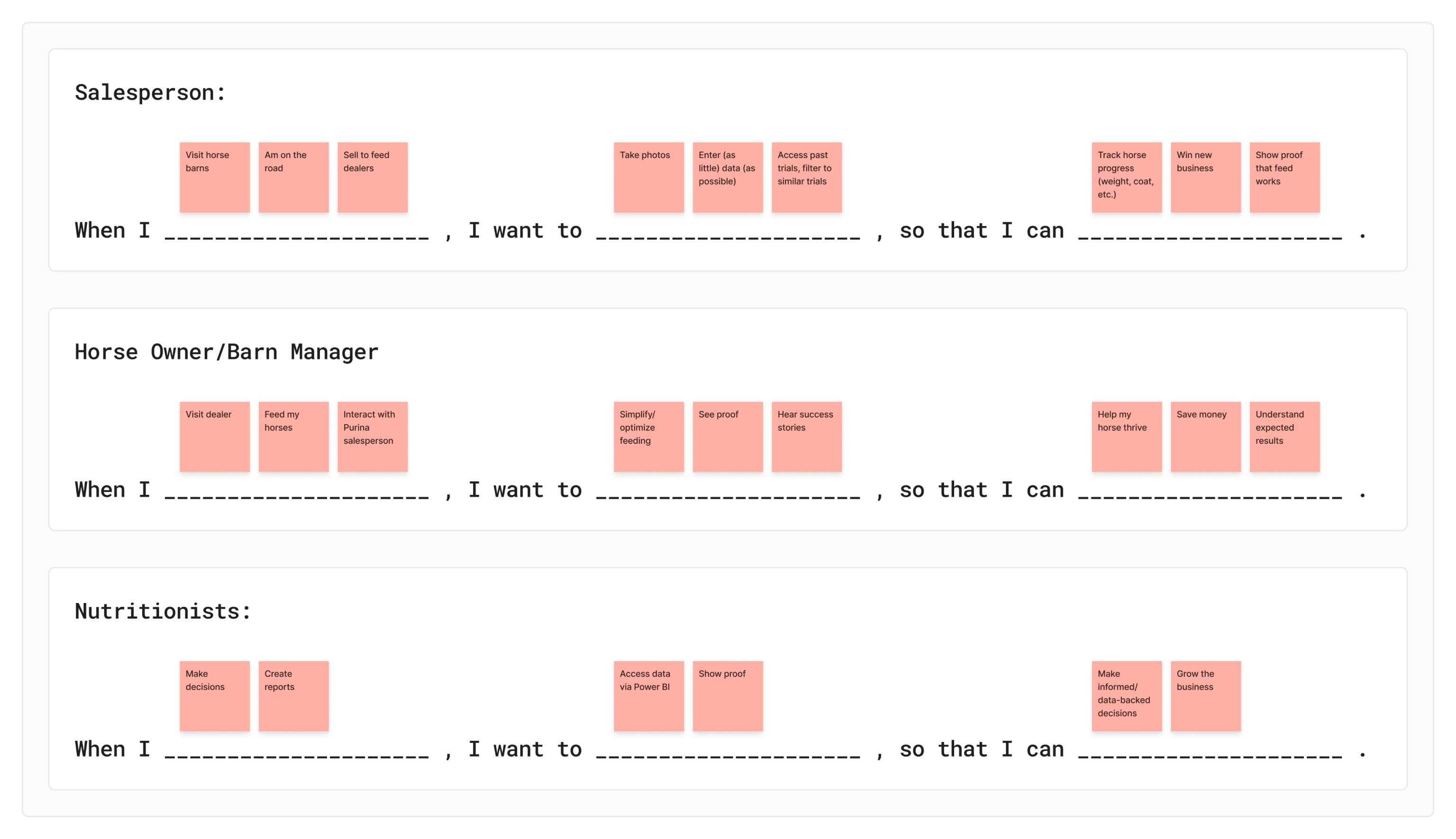
We took a JTBD approach to understanding our users so that we could focus on why they’ve hired this app, along with the greater context surrounding their app experience.
Journey mapping
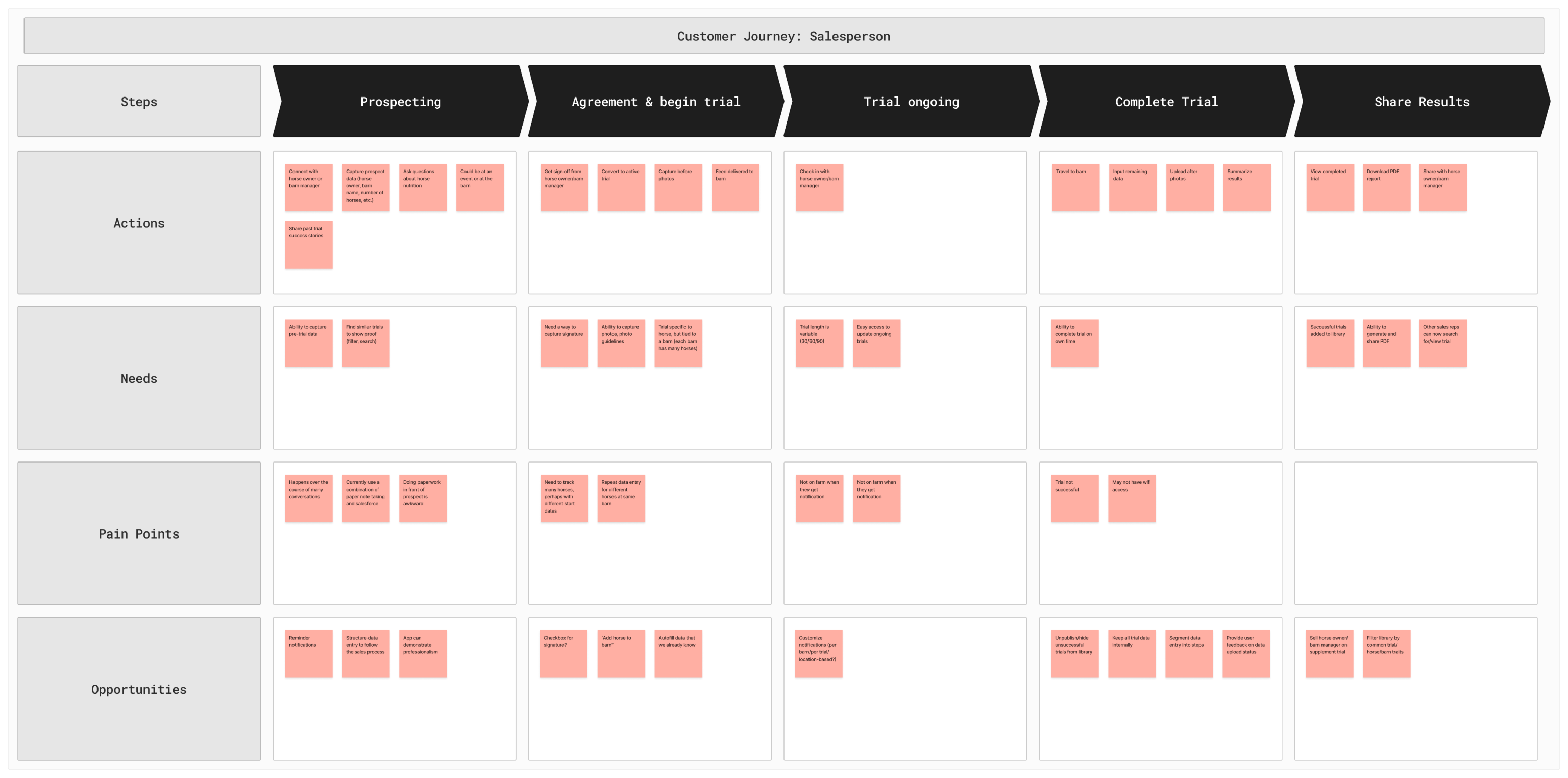
We outlined the journey for our primary user – the salesperson. This exercise allowed us to align on the sales process, and unveil opportunities to make it better via the app.
Approach
UX Strategy
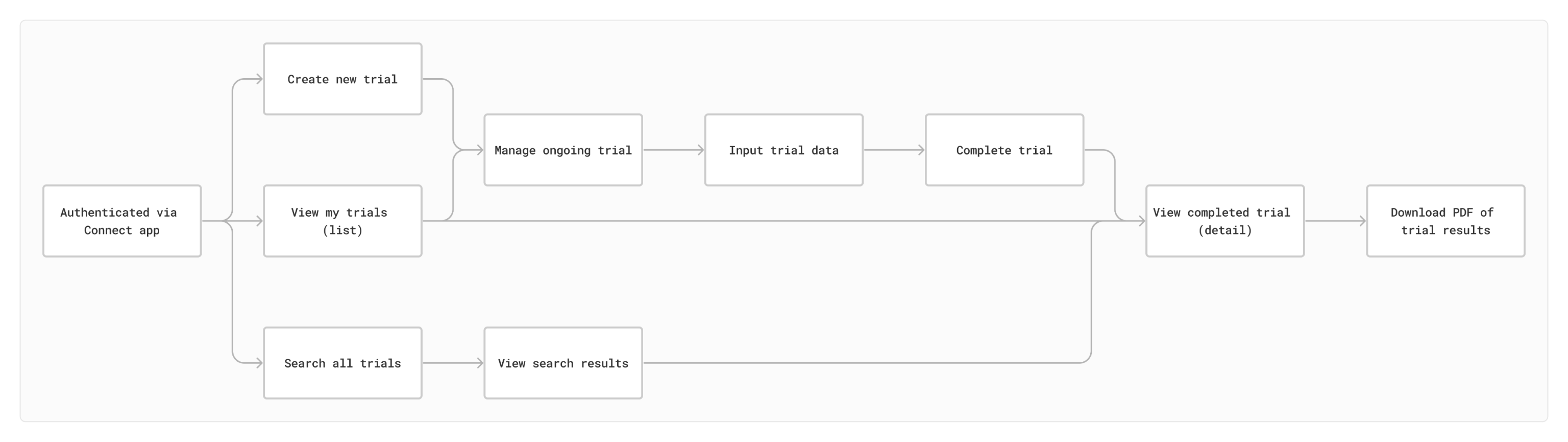
The app is broken out into 3 main flows: creating a new trial, updating ongoing trials, and viewing a library of past trials. The Purina team came to us with a long list of requirements for data capture, and together we architected the data entry process to make it as seamless as possible by mirroring their existing sales process. This included streamlining how the sales team captures data by creating efficiencies like auto-filling data that the system already knows.
To aid adoption, we built the new application right into a tool that the sales team is already using. This means nothing new to download and no new accounts to create; user authentication happens right through their existing sales tool, Modus.
User flows
We outlined the 3 main flows: creating a new trial, updating ongoing trials, and viewing a library of past trials.
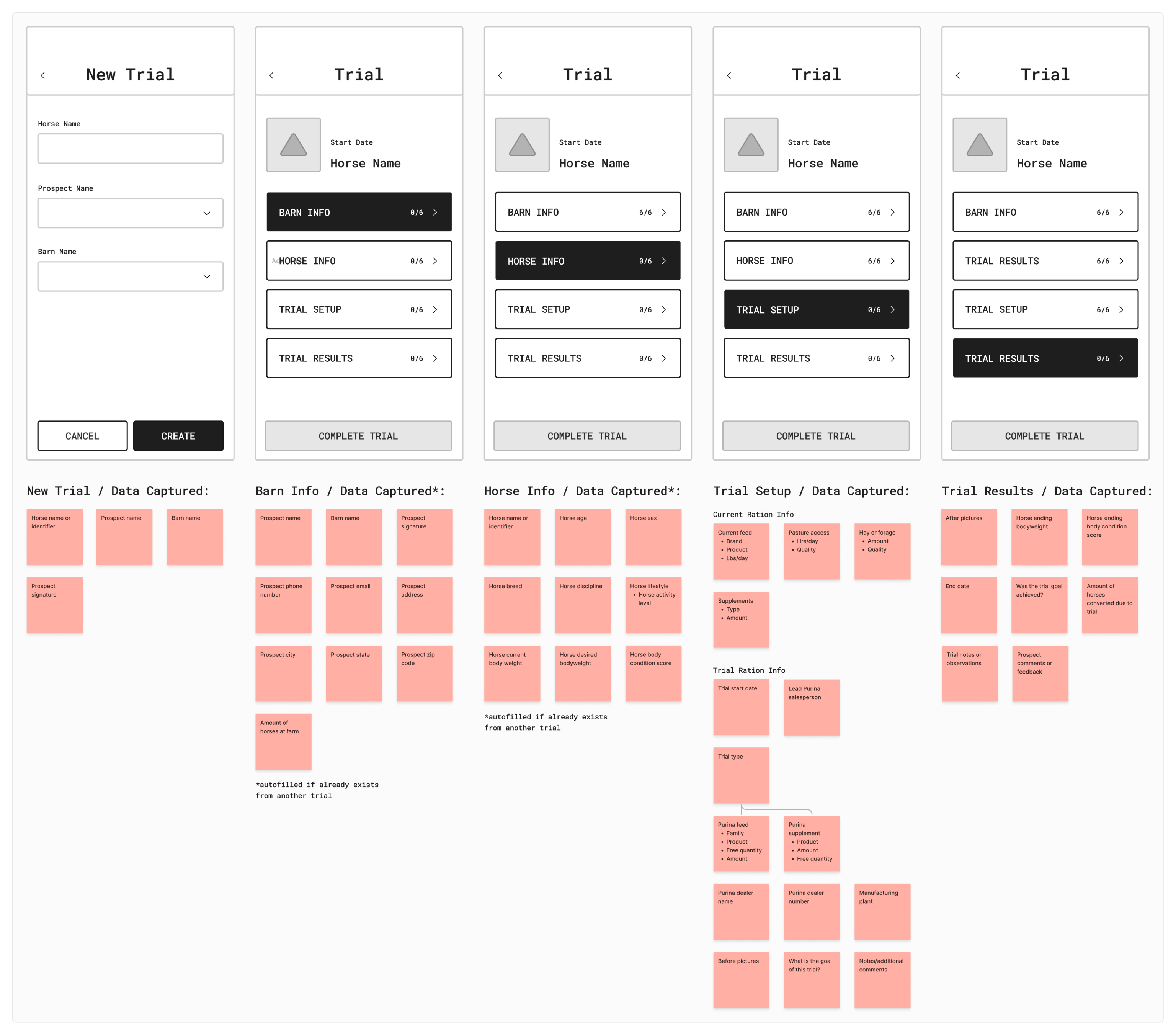
Wireframing and data architecture
As we developed lo-fi wireframes, we also architected the data entry process.
Design highlights
Since trial data isn't entered all in one session, we broken the data collection into sections that mirror how a trial occurs. For example, during the early prospecting a sales person is collecting information about the barn while they are building a relationship with the barn manager/horse owner. In the app, the sales person can go to the "Barn Info" section and fill out only that information.
Later on (days or weeks later), once the barn manager/horse owner has agreed to a trial, they can enter details about the feed or supplement they will be trialing by navigating to "Ration Details". Breaking the form up ensures that we don't overwhelm either party, while collecting necessary data at the right time.
Hi-fi prototype
Check out this end-to-end walkthrough of the application, created in Figma.
Conclusion and considerations
The visual design of the app was kept clean and simple, with small touches of Purina branding, due to it being an internally facing tool. The only client facing piece of the tool is a PDF that is generated once a trial is completed.
Given more time and budget, we would have liked to design an interface within the app for trial results, rather than generated a PDF. Ideally, we could show data visualizations on the improvements that the horse has made.

Back to all work
All work represents professional projects. Sensitive information and proprietary details have been omitted to respect confidentiality agreements.
© Kelsey Kohlman 2026. All rights reserved.
Kelsey Kohlman
Work
About
Get in touch

Purina
Streamlining field sales through paperless trial tracking and data collection.
Role
Lead Product Designer
Rest of team
Project Manager | Support Product Designer | Lead Engineer & Team
Overview
Challenge
The Purina sales team is busy. They are in the field (literally) at horse barns and feed distributors daily. Feed and supplement trials are the number one conversion tool for the sales team, but rely on data collection that historically has been done via pen and paper. You can imagine the amount of misplaced and incorrectly filled out forms.
Solution
We designed and developed a sales enablement tool that leaves the paper processes behind and centralizes trial data. This means a streamlined data entry process, easier access to a library of past trials, as well as access to trial data for other business units. We also met the technical requirements of integrating with Power BI and deployment within their existing sales tool, Modus.
Impact
The app was launched to 500+ folks in Fall 2024 at Purina’s National Sales Meeting. Initial feedback was extremely positive, with excitement to “finally have a tool like this one after years of inconsistent and old school tracking methodology”.
The team hopes to add support for additional animal species in the near future.
Discovery
Workshop
Purina came to us with their goals and objectives, as well as some initial requirements for the app. With that in mind, our initial workshop was designed to align our teams and fill in the details by defining users and their needs; main user flows and data capture requirements; and short, medium, and long-term goals for the application.
🔮 Product vision
The Vision: “Provide sales team an easily usable app interface for tracking trial journey. Ability to search and leverage past trial results to show proof of trial success and help facilitate new trials.”
Jobs-to-be-done
We took a JTBD approach to understanding our users so that we could focus on why they’ve hired this app, along with the greater context surrounding their app experience.
Journey mapping
We outlined the journey for our primary user – the salesperson. This exercise allowed us to align on the sales process, and unveil opportunities to make it better via the app.
Approach
UX Strategy
The app is broken out into 3 main flows: creating a new trial, updating ongoing trials, and viewing a library of past trials. The Purina team came to us with a long list of requirements for data capture, and together we architected the data entry process to make it as seamless as possible by mirroring their existing sales process. This included streamlining how the sales team captures data by creating efficiencies like auto-filling data that the system already knows.
To aid adoption, we built the new application right into a tool that the sales team is already using. This means nothing new to download and no new accounts to create; user authentication happens right through their existing sales tool, Modus.
User flows
We outlined the 3 main flows: creating a new trial, updating ongoing trials, and viewing a library of past trials.
Wireframing and data architecture
As we developed lo-fi wireframes, we also architected the data entry process.
Design highlights
Since trial data isn't entered all in one session, we broken the data collection into sections that mirror how a trial occurs. For example, during the early prospecting a sales person is collecting information about the barn while they are building a relationship with the barn manager/horse owner. In the app, the sales person can go to the "Barn Info" section and fill out only that information.
Later on (days or weeks later), once the barn manager/horse owner has agreed to a trial, they can enter details about the feed or supplement they will be trialing by navigating to "Ration Details". Breaking the form up ensures that we don't overwhelm either party, while collecting necessary data at the right time.
Hi-fi prototype
Check out this end-to-end walkthrough of the application, created in Figma.
Conclusion and considerations
The visual design of the app was kept clean and simple, with small touches of Purina branding, due to it being an internally facing tool. The only client facing piece of the tool is a PDF that is generated once a trial is completed.
Given more time and budget, we would have liked to design an interface within the app for trial results, rather than generated a PDF. Ideally, we could show data visualizations on the improvements that the horse has made.
Back to all work
All work represents professional projects. Sensitive information and proprietary details have been omitted to respect confidentiality agreements.
© Kelsey Kohlman 2026. All rights reserved.
Introduction
Discovery
Approach
Design highlights
Conclusion